

Quality-first AI code review and test generation platform featuring multi-agent pull request analysis, cross-repo dependency checking, and enterprise governance across IDEs and Git workflows.
Starting price Freemium / $30.00/mo

Tool Information
Overview and architecture
Qodo AI (formerly CodiumAI) is an enterprise code review, testing, and software quality governance platform. Founded by Itamar Friedman and Dedy Kredo, the company rebranded to Qodo to reflect a broader operational focus: establishing quality control frameworks for modern development environments where both human engineers and autonomous AI agents generate substantial code volumes.
Rather than functioning merely as an inline autocomplete widget, Qodo addresses the systemic review bottleneck in software engineering. As generative AI increases code output across development teams, senior engineers face overwhelming pull request backlogs. Qodo resolves this friction by deploying specialized autonomous agents across the software delivery lifecycle. The platform evaluates proposed changes not as isolated diff files, but as cohesive work packages contextualized against complete repository architecture and cross-service dependencies.
Architecturally, Qodo operates across two primary integration tiers. Locally within editor environments (VS Code and JetBrains), Qodo Gen provides contextual test generation, boundary condition analysis, and pre-commit self-review. Concurrently within continuous integration and Git hosts (GitHub, GitLab, Bitbucket, and Azure DevOps), Qodo Merge acts as an automated reviewer. It runs static analysis, executes semantic checks against linked issue tickets, flags breaking changes across related microservices, and classifies feedback into actionable severity levels.
Key capabilities and modules
The Qodo platform encompasses specialized modules designed to uphold code integrity at every stage of development:
- Agentic pull request code review: Automatically analyzes incoming pull requests, writes descriptive summaries, verifies commit intent against issue trackers, and identifies logic regressions before human review.
- Context-aware test generation: Produces meaningful unit tests, integration test suites, and mock data directly within the IDE, targeting uncovered edge cases and uncommon runtime inputs.
- Cross-repository impact detection: Tracks symbol definitions and API contracts across multi-repo ecosystems, warning engineers if a local change will break downstream microservices.
- Custom rule and governance enforcement: Allows engineering managers to define natural language and structured architectural policies, ensuring compliance with team standards across all PRs.
- Prioritized severity triage: Sorts review comments into High, Medium, and Low tiers with clear rationales, eliminating notification fatigue and focusing developer attention on critical bugs.
- Enterprise security and air-gapped deployment: Complies with SOC 2 Type II and GDPR standards, offering zero data retention policies, bring-your-own-key (BYOK) options, and on-premises hosting.
Competitor comparison
The following table benchmarks Qodo AI against alternative automated code review and testing solutions:
Practical use cases and target audiences
Qodo AI serves distinct organizational functions within modern development teams:
- Accelerating engineering pull request reviews: High-velocity teams rely on Qodo to execute first-pass reviews, verify formatting, check edge cases, and draft documentation before humans review.
- Augmenting unit test coverage: Software developers writing complex algorithms generate robust test matrices covering zero values, boundary thresholds, and exception handlers in seconds.
- Governing multi-service microservices: Engineering organizations operating hundreds of interdependent services catch breaking schema modifications before deployment to staging environments.
- Overseeing autonomous AI code generation: Engineering leads supervising autonomous coding agents deploy Qodo as an independent verification gate to ensure generated pull requests meet strict internal standards.
Hardware, quota and file limitations
When implementing Qodo AI across team infrastructure, consider the following technical parameters:
- Credit pool consumption: Pro Team plans operate on a monthly team credit pool. Large pull requests with extensive diff files consume credits proportionally based on token volume.
- Network and webhook connectivity: Cloud-managed review workflows require active webhook communication between your Git host and Qodo cloud services.
- Advanced self-learning system: Repository-specific fine-tuning and adaptive learning from past human review decisions require an Enterprise tier agreement.
- Local IDE resource utilization: Running extensive local test generation tasks within VS Code or JetBrains creates brief memory spikes while parsing AST trees, requiring modern developer hardware.
Pricing breakdown
Qodo provides transparent self-serve options for individual developers and teams, alongside customized enterprise deployments:
*Pricing and plan details verified as of October 2026.
Implementation and onboarding pipeline
Setting up Qodo AI across an active software engineering team follows four structured phases:
- Install Git integration: Connect Qodo to your organizational Git host (GitHub App, GitLab integration, or Bitbucket plugin) and select target repositories for automated review.
- Configure organizational rules: Establish guidelines for code styling, required test coverage thresholds, security patterns, and PR description formatting via the web dashboard.
- Deploy IDE extensions: Developers install the Qodo Gen plugin in Visual Studio Code or JetBrains IDEs to run pre-commit checks and generate unit tests locally.
- Execute automated reviews: Open a new pull request. The Qodo agent immediately analyzes the diff, posts structured review feedback with severity labels, and provides verified fix suggestions.
Final Verdict
- Best for: Development teams, engineering leads, and DevOps managers seeking to eliminate pull request bottlenecks, improve test coverage, and govern code quality across distributed repositories.
- Not recommended for: Solo programmers looking exclusively for casual typing autocomplete without interest in structured testing or review workflows.
- Learning curve: Low to moderate. The Git integration functions automatically on pull requests without manual intervention, while IDE test generation tools are intuitive.
- Value threshold and ROI: High. At $30 per month for teams, catching even one production-breaking bug or halving pull request review cycle times yields immense return on investment.
- Bottom line: Qodo AI redefines developer tooling by shifting focus from unvetted code volume to rigorous, agentic code integrity and verification.
F.A.Q
Pros and Cons
Pros
- Performs automated multi-agent code reviews directly inside Git pull requests
- Generates comprehensive unit tests and detects overlooked boundary edge cases
- Enforces custom organizational coding guidelines without noisy false alarms
- Analyzes cross-repository dependencies to prevent downstream breaking changes
- Integrates across GitHub, GitLab, Bitbucket, Azure DevOps, VS Code, and JetBrains
Cons
- Free tier is restricted to individual developer IDE usage without team PR review
- Advanced self-learning capabilities and on-premises hosting require Enterprise contracts
- Complex pull requests with thousands of lines can consume team credit pools quickly
Reviews
There are no reviews yet. Be the first one to write one.
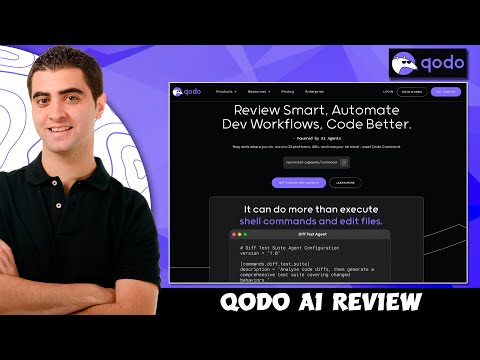
Qodo Ai Review - Is It Worth It | Best AI Agents For Code, Reviews 2025
How to Choose the Right AI Code Review Tool | Qodo Academy
Author

Promote

Alternative tools

Ultra-fast AI code completion tool featuring a 1-million-token context window and sub-300ms latency across VS Code, JetBrains, and Neovim development environments.
2026-10-29
Freemium / $10.00/mo

AI SDK is an open-source TypeScript toolkit by Vercel for building AI applications, streaming chatbots, structured data pipelines, and agents.
2026-09-25
Open Source

Enterprise AI developer platform and autonomous software factory featuring deep codebase context indexing, agentic code reviews, and sub-second completions across large multi-repo architectures.
2026-10-29
Paid / $20.00/mo

AI Code Converter translates code snippets between 50+ programming languages, generates syntax from text, and explains logic directly in your browser.
2026-09-25
Free

Enterprise AI coding assistant powered by Sourcegraph code intelligence, multi-repo context graphs, and leading frontier models across VS Code, JetBrains, and Web environments.
2026-10-29
Enterprise / From $16,000/yr

JetBrains AI Assistant is a deeply integrated in-IDE coding companion that leverages project structure, multi-model routing, and local AI completion across all JetBrains IDEs.
2026-09-08
Free Trial / $10/mo